For students aspiring to be journalists the question of whether to go to graduate school is often puzzling. Many students ask: Do you need a graduate degree in journalism in order to be successful, or better yet to obtain your first journalism job? The Huffington Post’s article poses the question: Is Journalism Grad School Worth It? Some of the biggest advantages to enrolling in graduate school could be to gain further professional connections and a graduate degree could give you a higher edge upon entering the industry. In addition, receiving a graduate degree in journalism will only further refine your resume and provide you with proficient clips to share with your future employers. If you decide graduate school is the right path for you it is essential to look into top schools to enhance your experience. According to the Education Portal, The University of Missouri and Northwestern University are the top ranked schools for prospering journalism students to attend. My Many Eyes Data Visualization displays the remaining top colleges.
Inner Beauty Shines Through in Dove’s True Beauty Campaign
Dove released a new campaign video that has been viewed by millions of people all around the Internet. Dove’s Beauty Campaign is trying to tell women that they don’t have to be a supermodel to be beautiful. Dove’s video is trying to help women reach a higher self-esteem and recognize the true definition of beauty that lies within. The female participants in the video discover the individual beauty they each possess, and for some this discovery leaves an emotional impact. Overall, the participants are able to see how the outsider views their beauty and in the end this opens their eyes to lessen their insecurities. My popcorn video displays the key points of Dove’s Campaign. This interactive video displays an active Twitter feed highlighting viewers’ comments.
The Evolving Journalism Industry
Throughout my four-year college career, I have been enlightened to the fact that the journalism industry is constantly evolving and adapting to new patterns. The field of journalism is a young person’s field. As young journalists, we have lived within Journalism’s social media craze. We have developed an intuitive eye to help us tell stories. As aspiring young journalists, we know we will have to strive to perfect any advancement within our career path and work to build a definition for this constantly varying atmosphere we call the news industry.
Previous to the Conclusion, we were able to read about the changes occurring within the journalism industry. The Conclusion, highlighted those changes and evaluated the impact change will have on our future. The report’s Conclusion left my mind in a more hopeful state. The writing highlighted on what we as aspiring journalists need to do. Journalists need to adapt to these evolving tectonic shifts and be prepared for the changes we will face as the year 2020 approaches. Journalists need to understand that news will come from a wider variety of sources in the future.
People within the field “will concentrate less on questions of what is news and what isn’t than on questions like ‘Will my friends or followers like this?’” This occurring shift can be used as an advantage for any journalist. We are learning to use social media as a tool to widen the distribution of information, not just use it for social purposes. We are staying mindful to how many of our followers will like our news output. By the year 2020 the journalism industry will be far more polished and efficient.
Journalism is like a quilt, consisting of woven details, variety of sources, and a diversity of detail. In order to keep this quilt tightly sewn journalists need to find their talent, and expand their craft. “News isn’t a coherent or ontologically robust category; it is a constantly negotiated set of public utterances by a shifting set of actors.” Seeing as the news ecosystem is so vastly spread, journalists need to find their passion, expertise and excel in those areas.
The Conclusion brings everything together. It tells us to know ourselves. To gain an understanding of what we are good at and understand where we fall. We must begin to determine if we “are an interviewing journalist? A researching journalist? A Final Cut journalist? An Excel journalist? or A Hadoop journalist?” We must come to know when our network can help us. We need to “know when to work alone, when to call for help, when to partner outside our usual sphere.” Above all else once we learn these things, we must adapt and survive. Survivability is the greatest quality a journalist can have in this ever-changing news ecosystem.
Woof and Walk Holiday Adoption Event
The Danger of Wiki Leaks
The fact that the master controller of wiki leaks, decided to hack into government-owned private files became a danger for several top-secret U.S. government files were exposed and their contents were posted on Wiki Leaks. The fact that Wiki Leaks is still open to all internet users destroys our nation’s safety, for this information could potentially cause fatal disagreements. Questions to be considered are: Should the government be able to keep secrets from their nation? What would happen if there were no government or military secretes?Is the information put on wiki leaks even true? What if the information, or even parts of the content, is not true? While several of the leaks do support an anti-war plan, they also provide reasoning to continue the war against the Taliban. Also, many of the posted reports that come in often seem incomplete. This is risky. If people read these leaks and take everything seriously, if something happens to not be true, people will tend to believe that the daily record being kept by the government may necessarily not be the truth. Then individuals may view the government as being unjust. If the material being posted is not completely reliable I don’t think it should be disclosed to the public.
Hofstra Celebrates the Holidays
Hofstra officially kicked off this holiday season on Dec. 7 by inviting everyone to the Holiday Lighting Ceremony where Hofstra Hall became the highlight. Everyone gathered to enjoy its radiance cutting through the night sky. Hofstra University students and faculty were all encouraged to come out to the event.
Hofstra University students Belinda Darote and Kanisha Kennedy feel the campus Christmas lights give the cold nights a warmer feeling, a feeling of home. “I think that the lights add to our campus a lot. They add a Christmas feel that tells us the holidays and break are right around the corner which I know all students are anxiously waiting for,” said Darote.
“Christmas is my favorite holiday to celebrate. I think that the lights are a great idea and a great way to kick off this holiday season,” said Kennedy.”
Hofstra made this year’s theme: Sharing Children’s Stories. The over two dozen clubs and organizations wanted to put more of their funding towards purchasing a wider variety of crafts, to buy materials to paint murals and build 3D objects to create a Winter Wonderland display in the main dining room.
This year, Student Leadership and Activities Graduate Assistant Ashley Gray had a great deal of involvement in making this holiday season an eventful one. “‘Hofstra Celebrates the Holidays’ is different this year,” said Gray. “Last year student clubs and Greek organizations came together to build a big holiday village for local children to come and play in. This year things have been altered differently and more money has been spent on gifts and better crafts for our visiting children.”
‘Hofstra for the Homeless,’ a new club on campus goes to the Saratoga Inn, a homeless shelter located in Jamaica, Queens every Friday to help the kids with their homework. This Wednesday, students brought the children to Hofstra to do crafts with them.
The Kwanza Celebration took place Monday, Dec. 6 and was sponsored by the Black Student Union. The Chanukah Community Candle Lighting, sponsored by Hillel, will take place Sunday through Wednesday, Dec. 5-8, at 5 p.m., in front of the Student Center. A Christmas Mass sponsored by the Campus Catholic Parish will be celebrated on Sunday, Dec. 12 at 6 p.m.
Texting and Driving presentation is Reality Check for Students
“Many of us don’t think when we leave in the morning that we could lose our lives to texting, but we should be thinking. I can’t stress enough that texting and driving is a danger,” said Marcella. “The fatalities are expected to increase by 4 percent each year if we don’t change our ways. If I can walk away from here today and have made an impact on one person to help them stop texting and driving, I have done what I came here to do. ”
Years ago drunk driving was the main factor in fatal car crashes. Although drunk driving is still a problem, deaths have decreased more than 70 percent in 2010, according to Finlaw.com. On the other hand, deaths caused by texting and driving have topped the fatalities list and have increased 28 percent in 2010, according to the New York Personal Injury Journal. Over the past five years in the New York City area and Long Island area alone, there have been 100 deaths caused by texting and driving.
After watching the clip, one student in the crowd admitted to being in an accident from texting and said, “sadly, as bad as this may sound, my accident didn’t make me stop my habit of texting and driving.”
Sophomore and audience member Bari Morchower, had previously seen the public safety announcement prior to this presentation. She also admitted that she has been in a car with her friends when her life was placed in jeopardy from their poor driving decisions. “When I first watched the announcement, my roommate was in the room, and I was distracted. I kind of forgot about it. Seeing it again today, I can say I cried harder this time,” said Morchower. “I can’t believe how many times I have ridden in a car with someone who has been texting or using their iPod while driving. I thank God I am alive today.”
Erin Starke, a sophomore who also attended the event found Marcella’s presentation to be a very powerful one. Having admitted to hearing about this event while reading a text message at a stop sign in her car, she said, “After today’s presentation I will no longer text and drive. I haven’t been big on texting and driving because I know I’m not a very good multi-tasker. However, I will definitely read my texts in the car. When you know you got a text message it is hard to resist looking at it,” said Starke. “The videos shown by Marcella were real life videos and portrayed a very strong message. If the video’s had been censored they wouldn’t have had much of an impact on us.”
Anita Ellis, director of off campus living and commuter services, said she wanted people of all ages to be more informed of the dangers involved with texting and driving. “Lisa, Joseph Estrema, and I developed this program over the summer, and it came together smoothly,” said Ellis. “I am very happy over the publicity we received.”
Estrema couldn’t agree more. “It was very easy to work with Linda and to help coordinate a program in which I feel is very important for the student body,” she said. “Although our office addresses commuters, our events are sometimes relevant to all students.”
Veronica Gerosimo, Ellis’ graduate assistant also helped put together the program. She believed the main message audience members should take away from the presentation is “Anything can wait ten minutes. An emergency is never going to be texted to you.”
According to edgarsnyder.com, 2,600 people die each year from using cell phones while driving. “If you text and drive you’re placing everyone else’s lives in jeopardy,” said Marcella. “Before you get behind the wheel and think to text anyone. Think about how precious your life is, and encourage others to stop this terrible habit, for you may save someone‘s life.”
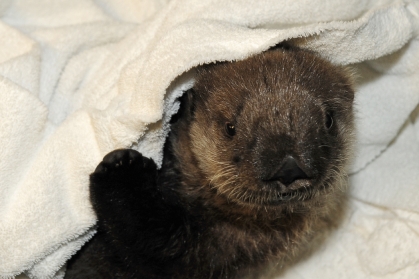
Orphaned Otter makes it to N.Y. -Reversed Engineer Audio Analysis-
I truly appreciate the way in which the story flowed. The story began by expressing the otter’s rough experience during a storm in Homer, Alaska which in the end separated him from his mother leaving him lonely, and and frightened. The frail otter was in danger and needed a miracle recovery.
The narrator of the story Dohlin highlighted Nicole Pisciotta the aquarium worked who helped the otter gain its strength leaving him overtime, strong enough to embark on his next journey to Brooklyn, New York’s Aquarium which became his new home. The otter was later named Tazo. The story concluded with his current age of five months. The story ended on a positive note stating how excited workers are to bring this new addition into the public and give him the attention he deserves.
As an animal lover myself. I was instantly attracted to the stories titled, and through listening to the interview I learned facts about otters that I had never knew. This story is filled with knowledgeable facts, and succinct radio reporting. I highly reccomend it to everyone to listen to.
Hofstra University holds knitting sessions for underprivileged youth
William Moriarty, a junior and the co-chair of the Pride Network feels there is a huge discrepancy of how many homeless youth are gay, lesbian, bisexual or transgendered. “Many young people get kicked out of their homes and take the street as soon as they come out to their parents, said Moriarty. “Several youth come from different parts of the country who believe they can make something of themselves there and not need anyone to support them.”
Moriarty encourages people to attend knitting sessions scheduled during GSA meetings. “Some of our members knit fairly well and regularly, so I encourage anyone who wants to learn to come to our meetings and get involved,” said Moriarty.
All finished products will be sent out to Love Threads, a national nonprofit organization in Washington, D.C. that aspires to raise public awareness of homelessness among LGBTQ youth. Moriarty and other club members are hopeful to see a large number of students lend a hand. “It is not required to attend our GSA meetings to get involved even though we always like to see new members,” said Moriarty.
Any student who has knitting experience and would like to make a donation is encouraged to do so. Gay Straight Alliance (GSA) meetings are scheduled every Wednesday at 9 p.m. in Brower Hall. Any student interested in supporting this cause can check out The Pride Network: Hofstra University Chapter on Facebook to see updates on any planned knitting sessions.
Members of the Pride Network will be at The Day of Dialog on Oct. 27 to promote the Threading for Youth event. Students who want to get involved can attend and start knitting. There will be a table set up in front of the bookstore for students to go talk to group leaders and actually sign out supplies on Nov. 4. Students can sign the pledge to take out crochet needles and yarn for completing winter accessories in room 260 of the Mack Student Center. All finished products must be returned in the same location by Nov. 22 at the latest.
Kimberly Rhyan, assistant director of Student Leadership and Activities, feels that acts of kindness can come in different forms. Not all forms require hands-on service. “We take putting a scarf on for granted but to some individuals to be given a scarf is a gift, a gift of warmth for the whole winter,” said Rhyan. “When most people are home snuggling over the holidays the homeless are going to be freezing. They need our help.”
Rhyan reflected on a homeless simulation she participated in during college. Upon being dropped off in the bitter cold of January at 5 a.m., Rhyan and her classmates pretended they were homeless. They were forced to determine where to find food and clothing. “We had people come up to us who were homeless and I can still remember their stories they told us. It was a life changing experience for me, “said Rhyan. “I love my job because I know I can always continue to open people’s eyes to those in need and encourage them to lend a hand and make a difference.”
Hofstra University’s VOICE Day 2010 Welcomes Outer Community Members
VOICE Day 2010 would not have had its large turnout without the help of Hofstra University Assistant Professor of Rehabilitation Studies Dr. Andrea Perkins, who took over the reins of the event as Chairperson in March. Perkins has been teaching at Hofstra for five years, and immediately became interested in running the event due to her profound interest of disability advocacy and activism. Planning for the event started as early as May and several meetings were coordinated over the summer to ensure that this event would turn out to be the best it could possibly be. “Hofstra has a very rich tradition in Disability History. Individuals, who were responsible for starting a lot of the major organizations for people with disabilities, include Dr. Frank Bowe, and Paul Hearne whom are graduates of Hofstra. Back in the 60’s, Hofstra was one of the only accessible campuses for people with disabilities in the country,” said Perkins. Her goals for making this event happen was to ideally create a standing group that would be able to come together and traditionally make this event happen for years to come.
“I was so thankful to have a great board ranging from 12 to 15 campus and community partners to help me plan and coordinate this event. The event was free for everyone. For the $2,000.00 budget we had, everyone really pitched in to make the event a positive one,” said Perkins. “The career center provided food and Hofstra student groups came together to help wherever they could.” Perkins wanted to expand the event more to help individuals learn about different programs available for people with disabilities, such as recreational groups geared towards all disabilities, and even services representing seniors.
Overall the event was geared towards being a celebration of helping individuals meet their potential. “I have been running events like this since I was in college. I attended Springfield College, which was responsible for first starting the YMCA it is very big on community involvement so dedicating my time to supporting others is just instilled in me,” said Perkins. “I think I’ve been doing this since I was about 18 and I truly enjoy event planning. I was in awe of the role models that Hofstra has provided Dr. Frank Bowe, Don Dryer, Robert Mauro, and Paul Hearne. If I can hold myself up to be half of what they were I would feel grateful.”Perkins was glad to have a lot of her students involved in this day as it was an opportunity for them to learn about Hofstra’s history, and all of the services available in the community.
Julie A. Yindra, Director of Services for Students with Disabilities, was glad to have Perkins lead the event this year stating: “Andrea was the center of the universe when it came to Voice Day.”Yindra went on to explain that in previous years rehab counseling coordinated a small scale film festival around disability awareness. Last spring Yindra was approached to become part of the board and was responsible of coordinating three specific aspects of the day. First being the transition room, where a series of schools and agencies came together to present disability and transition from childhood to adulthood. A number of agencies related to disability in transition present in the room talked about the kind of things students with disabilities need to be prepared for before transitioning to a career or higher education. There were a series of workshops that Yindra put together. The first panel discussion was based on college success. Yindra selected one recent Hofstra graduate, two current Hofstra students and a parent of a Hofstra student to discuss key readiness skills, attitudes and abilities that allowed these students to get to college and to be successful.
Richard Cavallaro, a junior at Hofstra University attended this event. “I was glad to be a part of Hofstra’s special day dedicated to students with disabilities. It was a great opportunity for people to be able to recognize that we are the same as everyone else. We are capable of achieving success and doing great things on the same level as any other student here at Hofstra,” said Cavallaro. “I feel Hofstra welcomed me on this campus and made my transition to college go smoothly, and for this I am thankful.”
The second and final panel discussion was based on topics related to Autism Spectrum Disorders and Aspergers Syndrome. This discussion covered the specific challenges students with that kind of disability undergo when they leave home to go to college or out into the work place. “They are a very unique group of people,” said Yindra. Present for this panel discussion were one graduate student at Hofstra, a parent of a Hofstra student who focused on the autism spectrum, and a professional whose job is to work with students with that type of disability.
“I think it was important to have this event at Hofstra particularly now after we just celebrated our 75th anniversary. We have a very long history of disability advocacy so I think as we reflect on our history it is important to recognize the roll we have played in disability services,” said Yindra. “Lastly, we have to celebrate one of our key populations in terms of celebrating diversity. On this campus there are a large number of students with disabilities. It is highly important to recognize the role these students play in ideally shaping who we are as a university.”